How to Book an Emergency Ambulance in Patna: A Complete Guide
July 17, 2026
Do you know what number to call during a medical emergency in Patna, or what details to share while requesting an ambulance? Most people don’t, and that is a scary situation to be in. Imagine your loved one collapsing in front of you and you scrambling for help while they fight every second to live. Whether it is a medical emergency or a planned hospital transfer, it is crucial to know what steps to take, whom to call, and what details to provide to book an ambulance in Patna. In this guide, we walk you through the entire process of booking an ambulance, right from the first call to the final handover to the hospital, to help you be prepared during critical moments.
Hospital-Based Ambulance Services
Many private hospitals in Patna operate their own ambulance fleet mainly to aid in the medical transport of patients already in their care or for cases like inter-hospital transfers, discharges, and emergency pickups (mainly for patients within the chosen radius). Some of the top hospitals in Patna offering such ambulance services include Ford Hospital and Research Centre, Paras HMRI Hospital & Emergency Services, BIG Apollo Spectra Hospitals, and ANS Multispeciality Hospital.
Step-By-Step Process: How to Book an Ambulance
Now that you have a clear idea of the kind of ambulance services available at your disposal, here’s what you need to do to book one for yourself or your loved one in minutes.
Step 1 – Assess and Identify the Type of Emergency
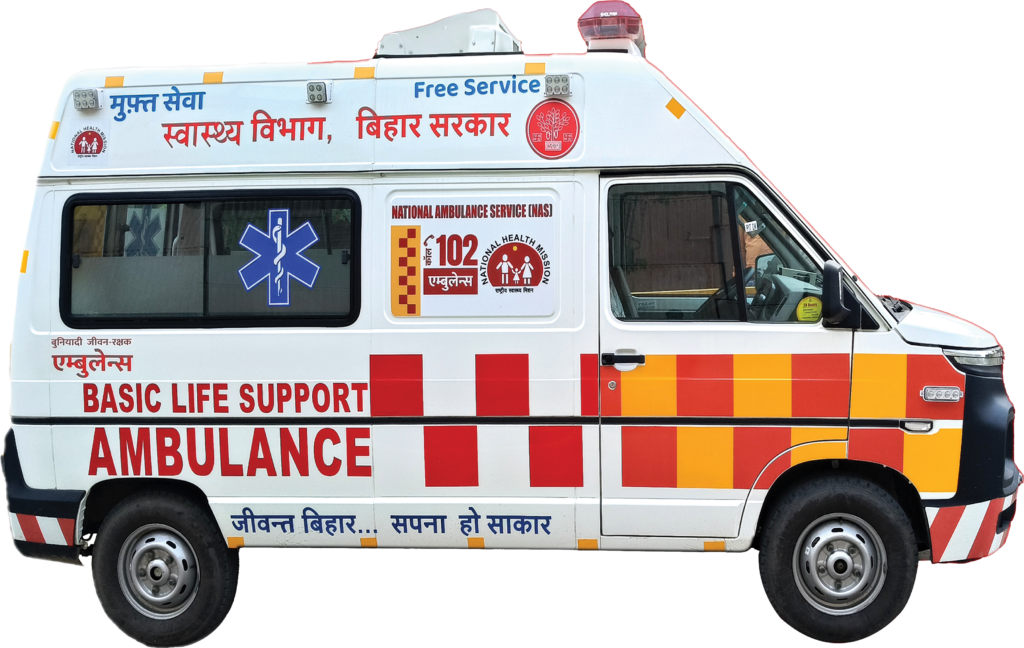
Before you reach out for medical help, take a moment to understand the situation and assess whether it is a life-threatening emergency or a non-critical medical need. This would help you decide whether to call the government ambulance number 102/108 or to seek a private ambulance service provider.
Step 2 – Make the Call
Depending on the type of ambulance service you choose, call the emergency number (for example, 102/108 for government). If you already have a private ambulance number stored in your phone, call it immediately.
Step 3 – Share Accurate Location and Patient Details
The operator will ask you questions regarding the patient’s condition, the type of emergency, and the accurate location. Ensure that you provide the correct details and try to be as specific as possible to help the operator analyse the situation and dispatch the right help to your location.
Step 4 – Follow the Operator’s Instructions and Keep Patient Company
In case of critical medical emergencies like accidents, bleeding, or cardiac arrests, it becomes crucial to provide the patient with timely medical care even before an ambulance arrives. In such cases, operators are trained to provide basic first aid and CPR guidance on call. Follow these instructions clearly and keep the patient company until help arrives.
Step 5 – Ambulance Arrival and Hospital Handover
Ensure that you prepare for the ambulance’s arrival by keeping the surroundings clear and providing easy access to the patient. Once the ambulance arrives, the crew initiates on-site stabilisation and ensures a safe and immediate transfer to the nearest or chosen hospital. The medical team provides continuous monitoring and medical support en route, ensuring complete patient care and improved survival chances.
Conclusion
Knowing how to book an ambulance is a basic necessity in today’s day and age. Medical emergencies can arise at any time, and being prepared can not only save precious time, but also make a real difference between life and death. Take a few moments today, save important emergency numbers like 102/108, learn the booking procedure, and share the knowledge with your loved ones. Because in an emergency, being prepared can be really helpful.
FAQs
- How much does it cost to book an ambulance in Patna?
Government-run ambulance services like 102 and 108 offer free services across Patna and all regions throughout India. However, other private and hospital-based providers may charge various rates depending on the type of ambulance service chosen, travel distance, and the level of medical care needed.
- How long does it take for an ambulance to arrive in Patna?
Response times vary depending on the patient’s location, ambulance demand, and traffic; however, most government and private ambulances aim to reach patients within 10 to 20 minutes across Patna.
- What should I do while waiting for an ambulance to arrive?
If the patient is in critical condition, listen carefully and follow any first aid or CPR instructions provided by the operator on call. This can help improve the patient’s chances of survival and lead to better outcomes.